
Directional Audio and “Sonic Weapons”: Separating Myth from Reality
WHAT AUDIO SPOTLIGHT® TECHNOLOGY CAN—AND CAN’T—DO
CURIOSITY AND MISUNDERSTANDING
Interest in directional audio has grown in recent years, fueled in part by media coverage, online discussion, and a general fascination with emerging technology. When people hear that sound can be “targeted” or “focused,” it naturally raises questions.
What does that actually mean? And how far can it go?
The curiosity is understandable. But as with many technologies, the conversation often blends real science with assumptions that don’t quite match how things work in practice.
Directional audio technologies like Audio Spotlight® are a good example. While the concept of directed sound is real, it is often interpreted in ways that don’t reflect the underlying physics.
WHERE THE MISCONCEPTIONS COME FROM
Some of the most common ideas surrounding directional sound suggest that audio can be delivered directly into a person’s head, influence perception or behavior, or even function as a kind of “sonic weapon.”
These ideas tend to surface whenever the technology is discussed more broadly. They reflect a genuine attempt to understand something unfamiliar but they do not align with how sound actually behaves.
To make sense of this, it helps to look more closely at how directional audio systems operate.
HOW DIRECTIONAL AUDIO ACTUALLY WORKS
Audio Spotlight technology uses ultrasonic carriers to create a narrow beam of sound. As this ultrasonic signal travels through the air, it generates audible sound along a defined path.
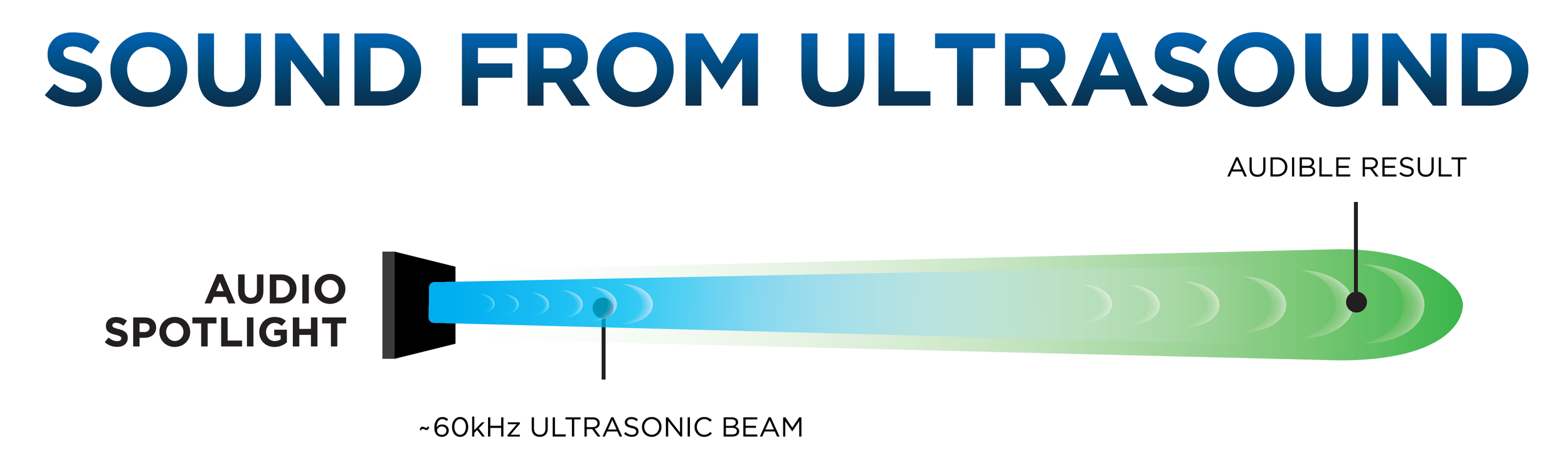
The key point is where that sound exists. It is created in the air—not inside the listener. From there, it is perceived through the normal process of hearing, just like any other audio source.
Like any acoustic system, directional audio requires air as a medium, proximity to the beam, and a clear line of sight between the speaker and listener.
The result is a highly controlled listening area, often compared to a focused beam of light. Within that beam, audio is clear and intelligible. Step outside of it, and the sound drops off quickly. Much like stepping into and out of a flashlight beam, the experience is clearly defined by position.
At its core, this is still conventional sound—simply delivered with greater precision.
WHAT IT CANNOT DO
Because directional audio operates within the same physical principles as all sound, it is subject to the same limitations.
It cannot transmit sound directly into a person’s mind. It cannot influence thoughts or behavior. And it cannot bypass normal hearing mechanisms.
Sound produced by these systems exists in space. It requires alignment between the source and listener, and it can be blocked, reduced, or avoided just like any other audible sound.
These constraints are fundamental—not situational.
More broadly, scientific analysis and expert evaluation have consistently found no acoustic mechanism by which sound could produce the kinds of effects often associated with so-called “sonic weapons.”
HOW DIRECTIONAL AUDIO IS ACTUALLY USED
In practice, directional audio is designed for clarity and control—not intensity.
It is used in environments where sound needs to be delivered to a specific location without affecting the surrounding space. In museums, it allows exhibits to speak to visitors without adding noise to the entire gallery. In retail settings, it enables individual displays to deliver audio without overwhelming the environment.
You’ll also find it in kiosks, digital signage, and banking environments, where clear, localized communication is essential.
In settings like hospitals and healthcare facilities—where quiet, focus, and non-intrusive experiences are especially important—directional audio can provide sound in a way that remains contained and controlled.
Across all of these applications, the goal is the same: to place sound precisely where it is needed, without adding to the overall noise environment.




CLARITY THROUGH UNDERSTANDING
Curiosity about emerging technologies is a good thing. But understanding those technologies requires looking at how they actually work.
Directional audio doesn’t change what sound is. It simply allows sound to be placed with far greater precision—delivered where it is needed, and kept from spreading where it isn’t.